
The final week of the month often feels like a race against an invisible clock. For many UK business owners, the “month-end crunch” is synonymous with a frantic scramble through spreadsheets, missing receipts, and unexplained balance gaps. Ignoring these discrepancies doesn’t just create a headache for your accountant; it leads to significant financial inaccuracies that can derail your growth. At KwikBooks, we specialise in reconciliation outsourcing, transforming that month-end chaos into a streamlined, automated process that ensures your SME remains agile and compliant.
At its core, bank reconciliation is the process of matching the balances in an entity’s accounting records for a cash account to the corresponding information on a bank statement. The goal is to ascertain the differences between the two and to book changes to the accounting records as appropriate.
For a busy SME, this is the ultimate “truth-check.” It provides financial clarity by ensuring that every penny leaving or entering your business is accounted for. A common issue many businesses miss is the “timing difference” such as a cheque issued but not yet presented, or an automated bank fee that hasn’t been logged in the internal ledger. Without catching these, your “available balance” is nothing more than a guess.
While the bank balance is a major piece of the puzzle, account reconciliation covers the broader spectrum of your balance sheet. This involves verifying the integrity of accounts beyond just cash, including vendor payments (accounts payable), client receivables, and tax accounts like VAT.
This practice is the bedrock of internal financial control. By cross-referencing your internal records against third-party invoices or sub-ledgers, you ensure that your liabilities aren’t understated and your assets aren’t puffed up. It’s the difference between thinking you have a profitable quarter and actually having the cash in hand to prove it.
Waiting until the month has already closed to fix errors is a reactive strategy that costs British businesses thousands in lost productivity. The real cost of disorganised financial data isn’t just a messy ledger it’s the risk of making critical decisions based on “ghost” numbers.
Poorly managed data affects your ability to forecast. If your accounts aren’t reconciled, your cash flow statement is essentially a work of fiction. This hampers your ability to:
Skipping or delaying this process invites disaster. From undetected bank errors to internal fraud or double-payments to vendors, the risks are substantial. A proactive pre-close process ensures that by the time the 1st of the month hits, your reports are ready for analysis, not surgery.
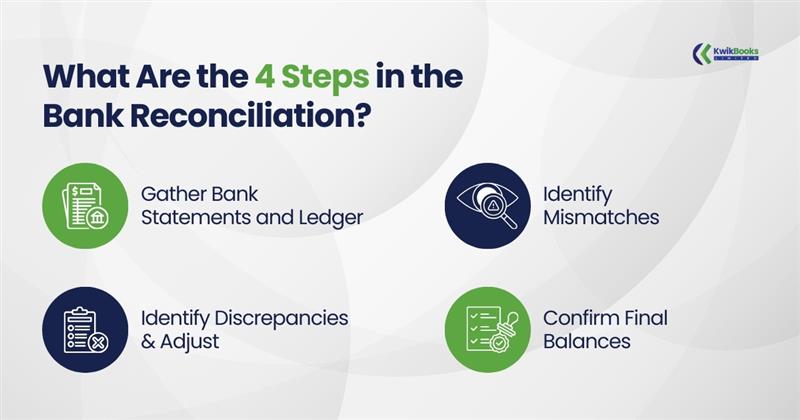
To maintain high financial accuracy, KwikBooks follows a rigorous four-step methodology. Following this structure ensures no stone is left unturned:
Completing a bank reconciliation should never be a guessing game; it is a mathematical certainty that provides a “clean bill of health” for your cash position.
If you are a small business owner handling this manually, use this checklist to stay organised:
Note: While manual spreadsheets are an option, they are prone to human error. This is where professional outsourcing simplifies the entire cycle, removing the manual burden from your plate.
Many people use these terms interchangeably, but they serve distinct purposes in a comprehensive financial health check.
Feature | Bank Reconciliation | Account Reconciliation |
Primary Focus | Cash and Bank accounts. | All balance sheet accounts (AP, AR, Payroll, Taxes). |
Source Data | Bank statements vs. General Ledger. | Sub-ledgers, vendor statements, and internal receipts. |
Primary Goal | To verify actual cash on hand. | To ensure all assets and liabilities are accurately stated. |
| Frequency | Ideally daily or weekly. | Typically monthly or quarterly. |
Ultimately, account reconciliation is the broader umbrella that ensures your entire business, not just your bank account, is in balance.
Most SME owners are experts at their craft, not at data entry. Finding the five to ten hours required per month to deep-dive into reconciliations often results in the task being pushed to the “next week” indefinitely.
As you grow, so does the complexity. Multiple payment gateways (Stripe, PayPal), various currencies, and high volumes of small transactions make manual matching nearly impossible and incredibly boring.
A simple typo—entering £1,050 instead of £1,500—can throw off an entire month’s reporting. Finding that single “needle in a haystack” error is a drain on efficiency and morale.
If the sales team is logging invoices differently than the operations team, the reconciliation process will highlight those departmental silos. This inconsistency leads to friction during year-end audits.
KwikBooks isn’t just a service provider; we are your external finance department. Based in the UK, we understand the specific VAT and regulatory requirements your business faces.
Outsourcing is often seen as a cost, but in the realm of bookkeeping, it is a significant saving.
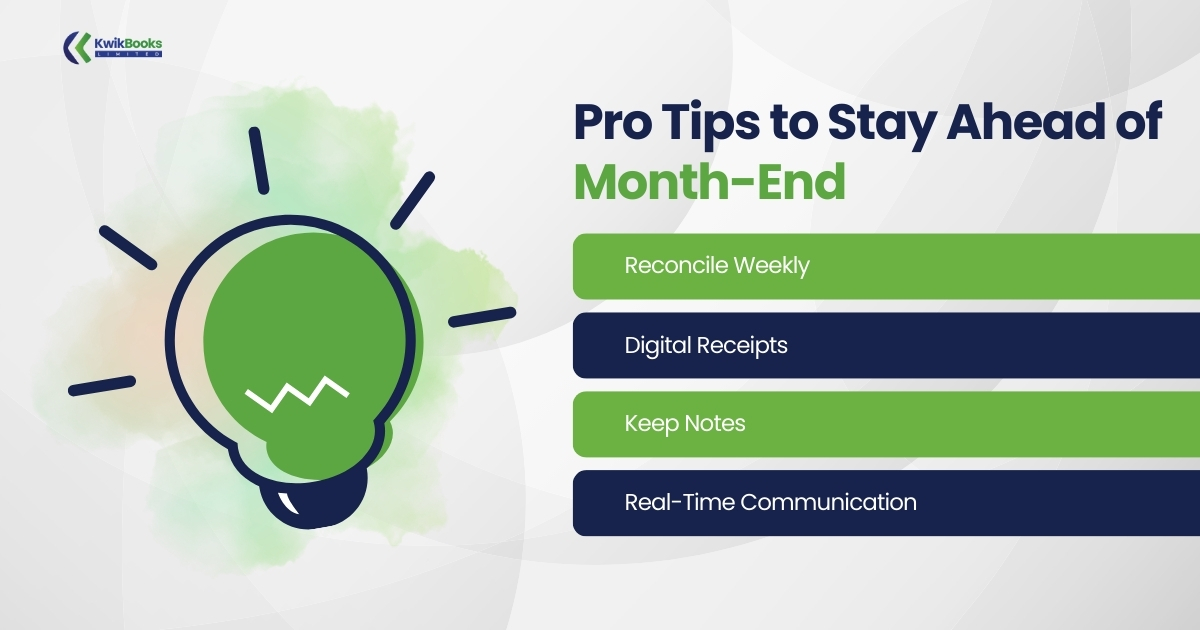
To make your life (and your bookkeeper’s life) easier, adopt these high-level habits:
Proactive financial management is the hallmark of a successful business. By prioritising regular reconciliations, you move from a state of “financial guessing” to “financial knowing.” Clean books provide the peace of mind necessary to lead with confidence, knowing that your cash flow is protected and your reporting is sound.
The month-end doesn’t have to be a period of stress and “messy books.” Outsourcing these technical tasks to a dedicated partner like KwikBooks ensures that your records are not only accurate but also work as a tool for your future growth. Let us handle the numbers so you can focus on the vision.
Need a reconciliation clean-up before the month ends? Don’t let another month slip by with unanswered questions in your ledger. Contact KwikBooks today to book a comprehensive reconciliation audit. Our UK-based experts are ready to tidy up your accounts and set you on the path to permanent financial clarity.