
Whether you’re a sole trader just getting started or a growing SME, understanding your cash flow is the backbone of a healthy business. Two of the most fundamental concepts in business finance are accounts payable (AP) and accounts receivable (AR), and yet, many business owners in the UK treat them as an afterthought.
At Kwikbooks, we believe every business owner deserves clarity around their finances. In this guide, we’ll break down what AP and AR really mean, why they matter, and how managing them well can transform your business’s financial health.
Accounts receivable refers to the money that customers or clients owe your business for goods or services you’ve already delivered but haven’t yet been paid for. In simple terms, it’s your outstanding invoices.
When you issue an invoice with payment terms (for example, ‘payment due within 30 days’), that amount sits in your accounts receivable until it’s paid. Until then, it’s recorded as an asset on your balance sheet because it represents money coming in.
Imagine you run a small graphic design business. You complete a project for a client in March and send an invoice for £1,500 with 30-day payment terms. Until that client pays, the £1,500 is part of your accounts receivable.
1. It directly affects your cash flow. Money owed isn’t the same as money in the bank
2. Poor AR management can lead to cash shortages even when your business appears profitable
3. Tracking AR helps you identify late-paying clients and take action sooner
4. It’s a key figure that lenders, investors, and HMRC may scrutinise
Accounts payable is the flip side: it’s the money your business owes to suppliers, contractors, or service providers for goods and services you’ve already received but haven’t yet paid for.
When you receive an invoice from a supplier, that amount goes into your accounts payable. It’s recorded as a liability on your balance sheet because it represents an obligation you need to settle.
Your cleaning company orders £800 worth of supplies from a wholesaler in April. They invoice you with 14-day terms. Until you pay that invoice, £800 sits in your accounts payable.
1. Staying on top of AP protects supplier relationships and your business reputation
2. Missing payment deadlines can result in late fees or disrupted supply chains
3. Managing AP well lets you strategically time outgoings to protect cash flow
4. It helps you forecast upcoming expenses and avoid nasty surprises
| Accounts Receivable (AR) | Accounts Payable (AP) |
Definition | Money owed TO you | Money you OWE others |
Balance sheet | Asset | Liability |
Source | Sales invoices issued | Purchase invoices received |
Cash flow impact | Increases when collected | Decreases when paid |
Goal | Collect quickly | Pay on time (but strategically) |
Together, accounts payable and receivable sit at the heart of your working capital the money available to fund your day-to-day operations. The gap between what you’re owed and what you owe is critical.
The time between when you spend money to deliver a product or service and when you receive payment from the customer is called the cash conversion cycle.
The shorter this cycle, the healthier your cash flow. Improving your AR and AP processes is one of the most direct ways to shorten it.
Consider this scenario: your business has £50,000 in outstanding invoices (AR), but also £35,000 in bills due this month (AP). Even though you’re “profitable” on paper, you could face a serious cash crunch if those invoices aren’t collected in time.
This is why profitable businesses sometimes still fail; cash flow management is not the same as profitability management.
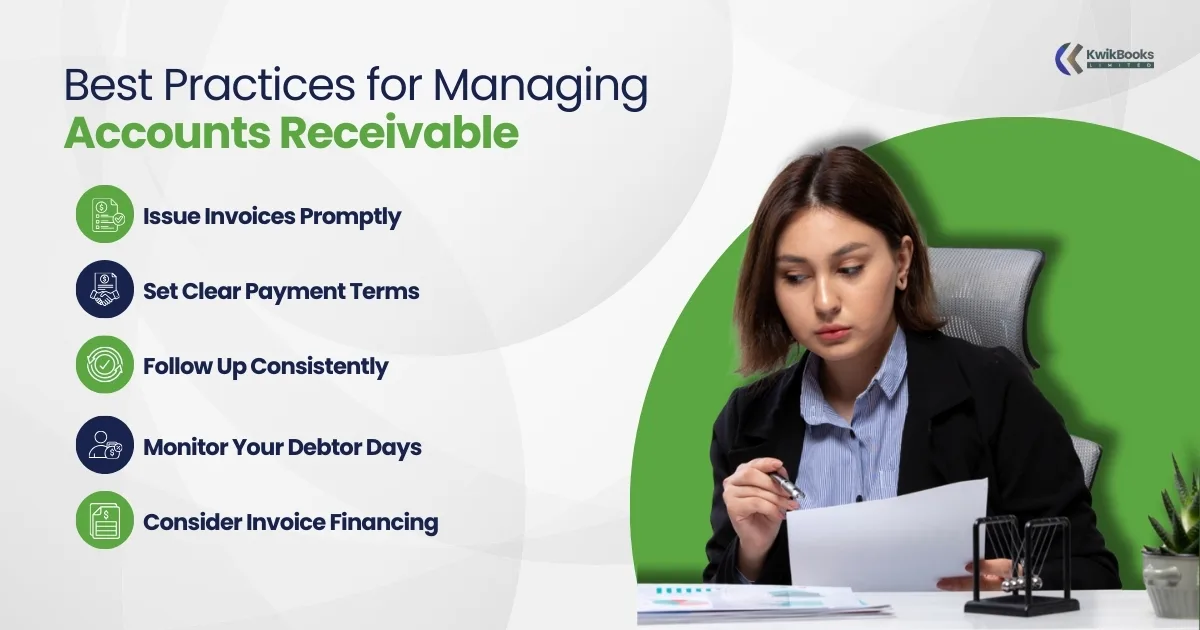
Send invoices as soon as a job is complete or a product is delivered. Delays in invoicing directly delay payment. Using cloud accounting software like Xero, QuickBooks, or FreeAgent can automate this process.
Be explicit about your payment terms from the outset. Common UK terms include 14, 30, or 60 days net. Shorter terms improve cash flow. Consider offering a small early-payment discount (e.g., 2% off for payment within 7 days) to incentivise prompt payment.
A polite reminder a few days before the due date and a firm follow-up the day after can make a significant difference. Many businesses use automated chasing sequences to do this without the awkwardness of personal follow-ups.
Your debtor days ratio tells you, on average, how long it takes customers to pay you. The formula is straightforward:
Debtor Days = (Accounts Receivable ÷ Total Credit Sales) × Number of Days
Example: If your AR is £10,000 and your annual credit sales are £120,000:
Debtor Days = (£10,000 ÷ £120,000) × 365 = 30.4 days
Compare this to your stated payment terms. If your terms are 30 days but your debtor days are 45, you have a collection problem.
For businesses with cash flow pressures, invoice financing (also called invoice factoring or discounting) allows you to unlock the value of unpaid invoices early, for a fee. This can be a lifeline when you’re waiting on large payments.
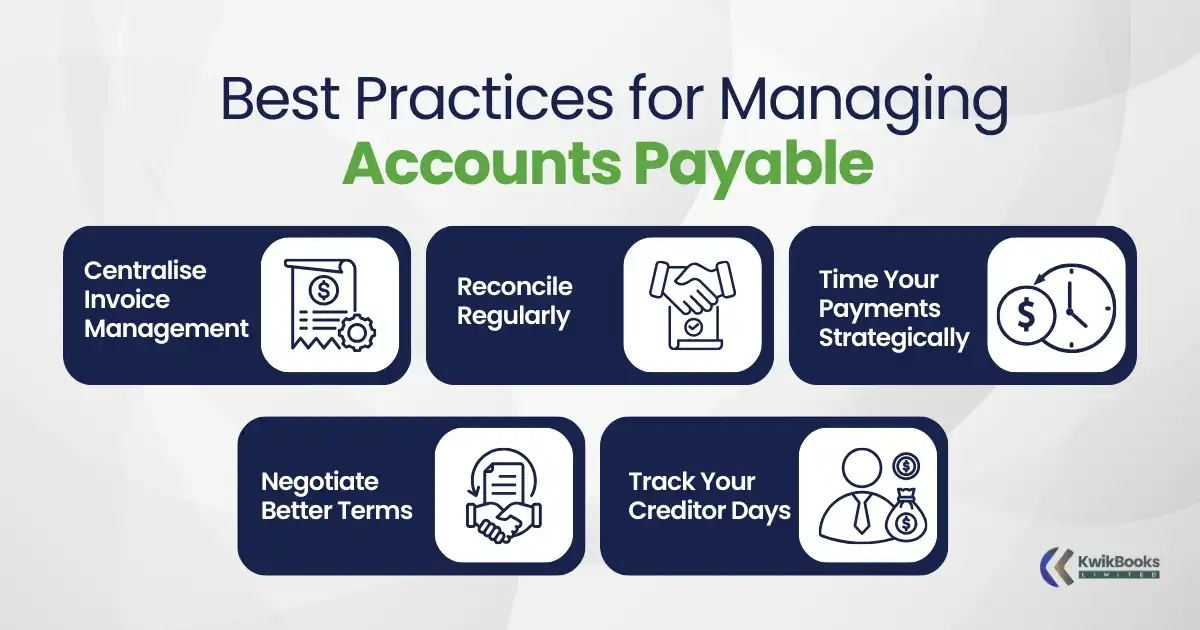
Keep all supplier invoices in one place, whether that’s an accounting platform or a dedicated AP inbox. This prevents invoices from slipping through the cracks and avoids duplicate payments.
Match your supplier invoices to purchase orders and delivery notes. This ‘three-way matching’ process ensures you only pay for what you actually received and at the agreed price.
There’s no benefit to paying a 30-day invoice in 2 days. Hold onto your cash for as long as possible while still meeting terms. Schedule payments on the due date (not before) to maximise your working capital.
Don’t be afraid to negotiate longer payment terms with suppliers, especially as your relationship matures. Even moving from 14-day to 30-day terms can make a meaningful difference to your monthly cash position.
Just as you track debtor days for AR, monitor creditor days for AP:
Creditor Days = (Accounts Payable ÷ Cost of Sales) × Number of Days
A higher creditor days figure means you’re holding onto your cash longer which is generally good, up to a point. Stretching suppliers too far, however, can damage relationships.
Modern cloud accounting platforms make managing AP and AR far more manageable for small businesses. Here’s how they help:
Popular platforms include Xero, QuickBooks Online, Sage Business Cloud, and FreeAgent. Many Kwikbooks clients use these tools alongside our bookkeeping services, giving them the best of both worlds: smart software plus expert human oversight.
Managing AP and AR properly takes time, discipline, and a clear system. For many small business owners, this is where things fall apart, not because of poor business skills, but because bookkeeping isn’t their core focus.
At Kwikbooks.co.uk, we offer:
Whether you’re a sole trader, freelancer, or limited company, we tailor our services to your needs and budget.
Get in touch today at kwikbooks.co.uk or email us to book a free consultation.
Understanding and managing accounts payable and receivable is critical for business success. By keeping track of money owed to you and by you, you can avoid cash flow issues, maintain vendor relationships, and continue growing your business. Whether you handle your bookkeeping in-house or outsource bookkeeping services to a professional, the key to managing AP and AR effectively is consistency and attention to detail.
At KwikBooks, we understand the importance of proper financial management. If you want to streamline your accounts payable and receivable, our expert team can help you implement the best practices to maintain smooth operations and maximize your cash flow. Get in touch today to learn more!
If you’re ready to take control of your business finances and streamline your accounts payable and receivable, reach out to KwikBooks for expert bookkeeping services tailored to your business needs. We’ll help you stay on top of your financial health, so you can focus on growing your business.