

Imagine you have been heads-down for months, winning clients, delivering work, and keeping the business moving. The last time you properly looked at your finances was… you cannot quite remember.
It is a scenario we see every week at KwikBooks. Running a business in the UK is demanding, and the books often end up being the last thing on the list. The problem is that financial trouble rarely arrives without warning. It leaves clues, quietly, over weeks and months, in your bank statements, your invoices, and your costs.
Most business owners only notice these warning signs once they become a crisis. By then, the options are fewer and the stress is considerably higher.
We have put together this guide, drawing on our experience working with UK small and medium-sized businesses across a wide range of sectors. These are the five most common financial red flags we encounter, what they mean, and what you should do the moment you spot them.
This is probably the most misunderstood financial problem in small business. Your Profit and Loss statement looks healthy. Revenue is up. But your bank account tells a very different story.
This gap between profit and cash is not unusual, but when it happens persistently, it is a serious warning sign. Profit is an accounting concept. Cash is what actually pays your suppliers, your team, and your tax bills.
Common signs of a cash flow problem include:
The UK reality: Late payment culture is a genuine problem for British SMEs. Invoice terms of 30 to 90 days are standard, and late payment on top of that creates liquidity squeezes even for growing businesses. According to the Federation of Small Businesses, late payments contribute to thousands of UK business failures each year.
Quick diagnostic: Compare your Profit and Loss statement against your actual bank balance at the end of each month. If they consistently diverge significantly, you have a cash flow management problem that needs addressing.
Our clients receive monthly cash flow snapshots as part of their reporting pack. Real-time bookkeeping means you can see your position clearly before decisions are made, not after the damage is done.
Sending an invoice is not the same as receiving money. Every unpaid invoice sitting in your accounts receivable is cash your business is owed but does not yet have. A growing pile of overdue invoices is one of the clearest financial red flags there is.
Warning signs to watch for:
The business impact is twofold. First, it ties up your working capital, leaving you cash-poor despite healthy-looking revenue. Second, it creates hidden bad debt risk: if a client eventually cannot or will not pay, that income disappears from your accounts but your costs were real.
An important VAT note: Under standard VAT accounting in the UK, you owe HMRC VAT on invoices when they are issued, not when they are paid. That means an unpaid invoice can still generate a tax liability you need to fund. This is one of the least understood financial risks for SMEs on standard VAT accounting.
What to do: Introduce a simple credit control process. Set clear payment terms on every invoice. Send automated reminders at 7, 14, and 30 days overdue. Consider aged debtor reporting as a standing monthly KPI.
We include an aged debtor report in every client’s monthly reporting pack. Knowing exactly who owes you, and for how long, puts you in a position to act early, not when it is already uncomfortable.
If your bookkeeping is not up to date, you are not running a business on information. You are running it on guesswork. And guesswork is expensive.
We regularly speak to business owners who have not reconciled their accounts in two or three months. They are making pricing decisions, hiring decisions, and investment decisions based on financial data that no longer reflects reality.
The risks of falling behind on your books include:
There is also a psychological trap at work here. When bookkeeping gets behind, it feels overwhelming to catch up. So it gets pushed further and further down the priority list. The backlog grows. The anxiety grows with it.
The modern solution: Cloud bookkeeping platforms like Xero and QuickBooks, connected to your bank feed, keep records current with minimal manual input. Outsourcing the day-to-day reconciliation removes the burden from you entirely, so the numbers are always ready when you need them.
Up-to-date books are not a luxury reserved for larger businesses. They are the foundation of good decision-making at every stage. Our model ensures your accounts are reconciled and current throughout the year, so there is no year-end scramble and no nasty surprises.
Revenue growth feels good. But if your costs are growing faster than your income, your business is quietly becoming less profitable with every passing month. This is margin erosion, and it is one of the most insidious financial red flags because it happens gradually.
Gross margin is the percentage of revenue left after direct costs. Net margin is what remains after all overheads. Tracking both on a monthly basis gives you an early warning system that an annual review simply cannot provide.
Common culprits behind margin erosion in UK businesses:
The challenge is that no single cost increase looks dramatic in isolation. It is the combination that creates the problem. A business that was running at 40% net margin can drift to 25% over 18 months without anyone noticing, simply because no one was tracking it systematically.
What healthy businesses track: Gross margin percentage by product or service line, and overhead as a proportion of revenue. Both should be reviewed monthly. If either is trending in the wrong direction, the time to act is well before it becomes a crisis.
We do not just record transactions. We categorise them so that your Profit and Loss statement gives you clear visibility of margins by area of the business. That is the difference between knowing your total revenue and actually understanding your profitability.
This is perhaps the most common financial red flag we see among sole traders and newer limited company directors: personal and business finances are being run through the same accounts.
It is understandable. When you start out, it feels simpler. But it creates serious problems on two fronts: clarity and compliance.
On the clarity side, mixing accounts makes it essentially impossible to:
On the compliance side: HMRC expects clear separation between business and personal expenditure. Personal expenses claimed as business costs are one of the most common triggers for tax investigations. For limited company directors, miscategorised director’s loan accounts create further complexity and potential tax charges.
The fix is straightforward: Open a dedicated business bank account and run all business income and expenditure through it. For limited companies, establish a clear and consistent approach to director salary and dividends. Do this from day one, or clean it up as soon as possible if it has drifted.
Investors, lenders, and accountants will look at this immediately. Clean, clearly structured accounts build credibility and trust. Messy ones raise questions.
Untangling mixed personal and business finances is one of the first things we tackle when a new client comes on board. We set up a clean chart of accounts, establish the right structure for their business type, and make sure everything going forward is categorised correctly from the start.
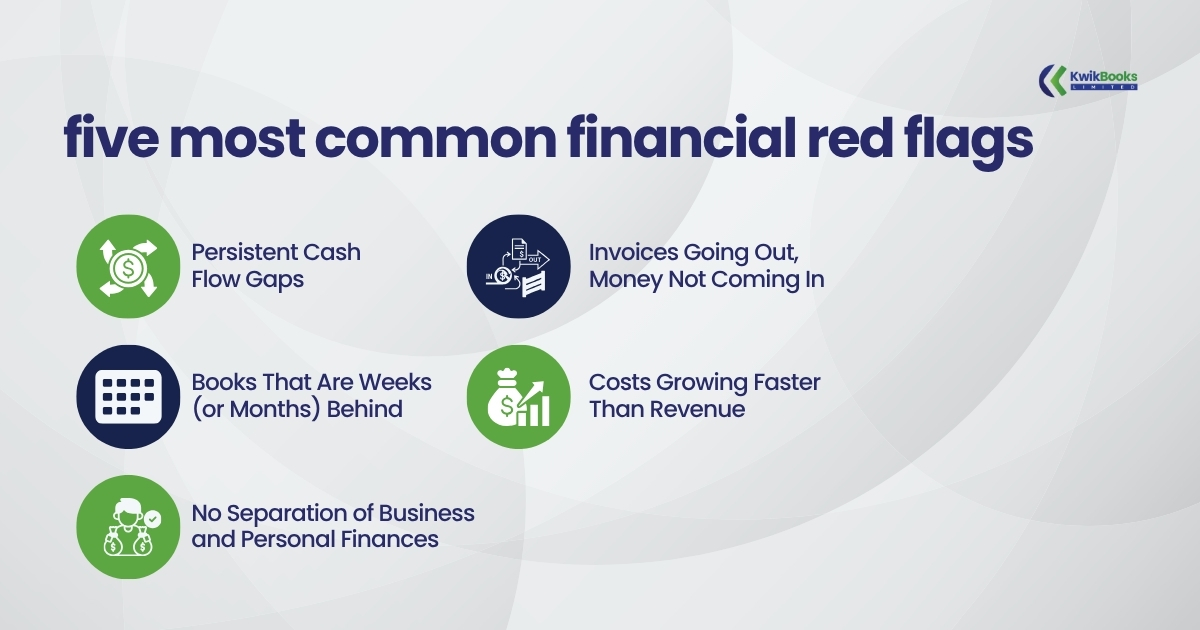
Run through these five questions honestly. They take less than two minutes.
If you answered yes to two or more of these questions, your books need attention.
The good news is that every one of these problems is fixable, and fixing them earlier is always easier and less costly than fixing them later.
Financial red flags are only dangerous when they go unseen. Every single one of the issues we have covered in this post is manageable when it is identified early. The businesses that struggle are not always those with the worst finances. They are often the ones where warning signs were present for months but went unaddressed.
The most straightforward way to stay on top of all five is to ensure your books are current, well-structured, and reviewed regularly. That is exactly what an outsourced bookkeeper does. Not just record-keeping, but a consistent, clear financial picture that lets you run your business with confidence.
At KwikBooks, we work with UK businesses of all sizes to provide professional, reliable outsourced bookkeeping that goes beyond data entry. We flag problems before they escalate, produce monthly reports that actually tell you something, and take the administrative burden of financial management off your plate entirely.