
Imagine you run a small web design agency based in Manchester. You have just wrapped up a major project for a client and sent them an invoice for £5,000 with a 30-day payment term. The work is done. The invoice is out. But the money has not yet landed in your account.
Now here is the question that trips up many business owners and accounting students alike:
The short answer is: Yes, absolutely. That unpaid invoice is classified as Accounts Receivable (AR), also referred to as Trade Debtors or Trade Receivables in UK financial reporting, and it is indeed a current asset on your balance sheet.
But understanding why requires a clear grasp of some fundamental accounting concepts. In this guide, KwikBooks breaks down exactly what accounts receivable is, where it sits in your financials, how it differs from similar terms, and why managing it well can make or break your business’s financial health.
Accounts Receivable (AR): known formally as Trade Receivables or Trade Debtors under UK accounting standards (FRS 102), refers to the money owed to a business by its customers or clients for goods or services that have already been delivered but not yet paid for. In simple terms, it is the outstanding invoices a company holds or the money clients owe it.
AR is created the moment a business extends credit to a customer, meaning the product or service is delivered before full payment is received. This is extremely common in B2B (business-to-business) transactions, professional services, and wholesale trade across the UK.
Sarah runs a management consulting firm in Birmingham. In January, she completes a strategy project for a tech start-up and sends an invoice for £8,000, payable within 30 days. From the date of invoice until payment is received, that £8,000 sits in Sarah’s books as Accounts Receivable (or Trade Debtors). It is money she is owed, money she has earned, but money she does not yet physically possess.
When a customer pays immediately at the point of sale like buying a coffee at a café or paying for a haircut, there is no AR created. The transaction is settled instantly. AR only arises when there is a delay between delivering a product or service and receiving payment.
Key Takeaway
Accounts Receivable = Money you have earned but not yet received. It is a promise of future payment, legally owed to your business. Under UK law, you have the right to charge statutory interest on overdue invoices under the Late Payment of Commercial Debts (Interest) Act 1998.
Yes — Accounts Receivable is unquestionably an asset. To understand why, let us first define what makes something an asset in accounting terms.
In accounting, an asset is any resource owned or controlled by a business that is expected to provide future economic benefit. Under FRS 102, the Financial Reporting Standard applicable in the UK and Republic of Ireland, assets can be physical (like machinery or stock), financial (like cash or investments), or intangible (like patents or trademarks).
For something to qualify as an asset, it must meet three criteria:
Accounts Receivable checks all three boxes perfectly:
Accounts Receivable (or Trade Debtors) appears in the Current Assets section of the balance sheet, typically listed right after cash and short-term investments. It is classified as a current asset because it is expected to be converted into cash within one year (or within the normal operating cycle of the business, whichever is longer). This classification follows Companies Act 2006 requirements for UK company reporting.
Current Assets:
Cash at Bank and in Hand – £20,000
Trade Debtors (AR) – £15,000
Stock – £8,000
Total Current Assets – £43,000.
Trade Debtors is one of the most important line items in your current assets section.
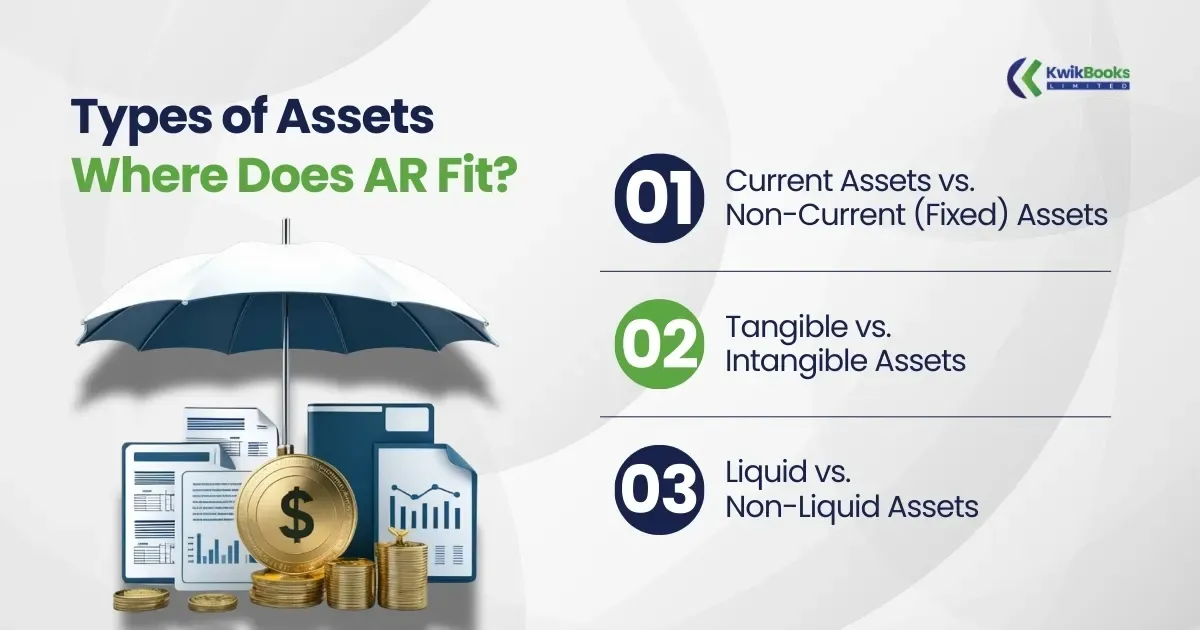
To fully appreciate AR’s role, it helps to understand the broader asset classification system used in accounting.
Current assets are assets expected to be used, sold, or converted to cash within one year. Non-current assets, referred to as Fixed Assets in traditional UK terminology, are those held for more than one year, such as property, plant, and equipment. AR falls firmly in the current assets category.
Tangible assets have a physical form, such as machinery, property, or stock. Intangible assets have no physical form but still hold value patents, trademarks, and goodwill. AR is a financial asset representing contractual rights to receive money, recorded under the Debtors heading in UK statutory accounts.
Liquidity refers to how quickly an asset can be converted to cash without significant loss in value. Cash is the most liquid asset. AR is considered highly liquid because it can often be converted to cash within 30 to 90 days or even sooner if the business sells its receivables to a factoring company, which is a widely used funding option for UK SMEs.
To truly master AR, you need to understand the ecosystem of related financial terms. Here is your UK-focused glossary:
While AR is money owed TO your business, Accounts Payable (AP), known as Trade Creditors in UK statutory accounts, is money your business owes TO others: suppliers, vendors, and service providers. It appears on the liabilities side of the balance sheet under Creditors: amounts falling due within one year. Think of it as the mirror image of AR. The Sales Ledger tracks what customers owe you (AR); the Purchase Ledger tracks what you owe suppliers (AP).
The balance sheet, formally called the Statement of Financial Position under FRS 102, is a financial statement that provides a snapshot of a company’s financial position at a specific point in time. It lists all assets (including AR), liabilities (including AP), and shareholders’ equity. The fundamental equation remains: Assets = Liabilities + Equity. UK companies registered at Companies House must file a balance sheet as part of their annual accounts.
The section of the balance sheet where AR lives. Current assets include cash, marketable securities, AR (trade debtors), stock, and prepaid expenses, all items expected to be liquidated within one year. For UK businesses with VAT obligations, any VAT recoverable from HMRC may also appear within current assets.
Net receivables are the total amount of AR minus any provisions for bad or doubtful debts. It represents the realistic amount of AR a business actually expects to collect. This is the figure reported on the balance sheet, not the gross AR total. UK accountants refer to this as the net debtor balance.
Not all AR gets paid. When a customer fails to pay, and the debt is deemed irrecoverable, it becomes a bad debt. This is written off as an expense in the Profit and Loss Account, reducing the business’s profitability. Bad debt is an unfortunate reality of extending credit, though UK businesses may be able to reclaim VAT on bad debts after six months under HMRC’s Bad Debt Relief scheme.
This is a contra-asset account, an account that reduces the value of AR on the balance sheet. Because businesses cannot always predict exactly which invoices will go unpaid, they estimate the amount likely to be irrecoverable and record it as a provision. This keeps financial statements realistic rather than overly optimistic, and is required under FRS 102 for UK entities.
Example (UK figures)
A company has £100,000 in Trade Debtors but estimates that £4,000 will not be collected. They record a Provision for Doubtful Debts of £4,000. Net Debtors (on the balance sheet) = £100,000 − £4,000 = £96,000.
DSO, often called Debtor Days in the UK, is a critical metric that measures how long, on average, it takes a business to collect payment after a sale has been made. It is calculated as: Debtor Days = (Trade Debtors ÷ Annual Credit Sales) × 365. The UK government recommends that large businesses pay suppliers within 30 days, and the Prompt Payment Code sets similar expectations. A rising Debtor Days figure is a warning sign worth investigating immediately.
Working capital measures a business’s short-term liquidity: Working Capital = Current Assets − Current Liabilities. Since AR is a current asset, it directly contributes to working capital. A business with efficient AR collection will maintain strong working capital — crucial for UK SMEs navigating seasonal cash pressures or periods of rapid growth.
This is one of the most critical distinctions in all of finance. Turnover (revenue in UK accounting terms) is recognised when a sale is made, even if cash has not been received yet. This is called accruals-based accounting and is required for most UK businesses. Cash flow, however, only counts money that has actually been received. AR represents turnover that has been recognised but has not yet become cash flow. This gap is why a business can show a healthy profit in its accounts but still struggle to pay its suppliers or PAYE obligations on time.
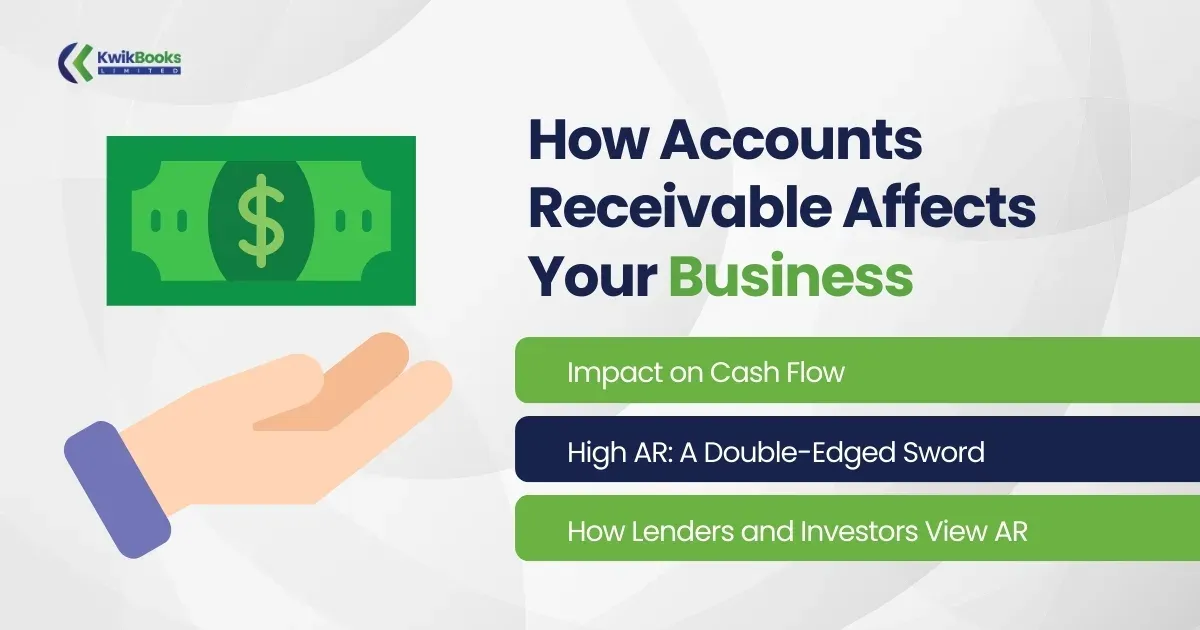
AR is often one of the largest assets for UK service-based businesses, but it does not pay the rent or the quarterly VAT bill. Until a customer pays their invoice, you cannot use that money to pay staff, purchase stock, or cover overheads. This is the classic cash flow trap: strong turnover and profit figures, but an empty bank account. This is a challenge felt acutely by freelancers, contractors, and SMEs across the UK.
Rising AR can be a sign of business growth: more sales, more customers, more revenue. But it can also be a red flag if it keeps growing because customers are not paying on time. High AR with slow collections can indicate poor credit controls, lax follow-up procedures, or customers experiencing their own financial difficulties. In the UK, late payment remains a significant challenge: research consistently shows that billions of pounds in late invoices are owed to small businesses at any given time.
When UK banks assess creditworthiness or investors evaluate a business, they look closely at AR. Strong, diversified AR with a low Debtor Days figure signals a well-run business with reliable customers. Concentrated AR (one customer owing most of the total) or a rising Debtor Days ratio raises risk flags. Some UK lenders offer invoice finance or factoring arrangements that allow businesses to borrow against their AR, which is a popular alternative finance option for growing SMEs.
Not quite. Turnover is recognised when the sale occurs. AR is the balance sheet representation of that turnover until it is collected. Turnover lives on the Profit and Loss Account; AR lives on the balance sheet. They are related but distinct concepts, and confusing them is one of the most common financial mistakes made by new business owners in the UK.
Having high AR does not guarantee profitability. A company could have millions in outstanding invoices but still be making a loss due to high operating costs or significant bad debt write-offs. Profitability is determined by the Profit and Loss Account, not the AR balance alone.
Unfortunately, no. Some customers default, go into administration, or simply refuse to pay. This is precisely why a provision for doubtful debts exists and why UK businesses must proactively manage their AR to minimise losses. Registering a County Court Judgement (CCJ) or using a debt collection agency are options available to UK creditors when invoices remain unpaid.
This is a common but incorrect belief. Assets are not limited to cash; they include anything of economic value that the business controls. AR represents a legal right to receive payment, which absolutely qualifies it as an asset under FRS 102 and the Companies Act 2006. The distinction is that it is not yet liquid, but it is still a genuine, recorded asset on your balance sheet.
Take a look at your own balance sheet today. Review your Trade Debtor balance and calculate your Debtor Days. If your outstanding invoices are growing and cash is tight, it may be time to tighten your collections process, review your credit policies, or explore invoice finance options. KwikBooks makes it easy to track AR in real time, send automated payment reminders, and stay MTD-compliant all in one place. Try KwikBooks free for 30 days.
To bring it all home: Yes, Accounts Receivable or Trade Debtors, as it is known in UK statutory accounts, is absolutely an asset, a current asset to be precise. It represents money your business has legally earned and is entitled to receive in the near future. It sits on your balance sheet as proof of business activity, creditworthiness, and future cash inflows.
But AR is more than just an accounting entry. It is a living, dynamic indicator of your business’s financial health. A well-managed AR balance means predictable cash flow, strong working capital, and a business that can sustain and grow its operations. A poorly managed AR balance means cash crunches, bad debt losses, and financial stress even in the middle of a profitable trading year.
Understanding the difference between AR and cash, turnover and cash flow, gross debtors and net debtors, these are not just textbook concepts. They are the building blocks of smart financial decision-making for any UK business owner, practice manager, or aspiring accountant.
Financial clarity starts with understanding what you own, what you are owed, and how quickly you can convert both into the cash that keeps your business running.