
An external audit can feel like an exam you didn’t have time to revise for except the syllabus is your entire financial year. The good news is that audit readiness is far less about cramming and far more about discipline practised consistently across twelve months. Businesses that treat their books as audit-ready by default rarely lose sleep when an auditor’s engagement letter lands in the inbox.
At KwikBooks, we work with UK companies that range from fast-scaling start-ups facing their first statutory audit to established firms that have been audited for years but want the process to run more smoothly. The pattern is consistent: the businesses that sail through are not the ones with the cleverest accountants on audit week, but the ones whose records were tidy long before the auditor arrived. This guide walks through exactly how to get there.
An external audit is an independent examination of your financial statements carried out by a registered auditor who has no involvement in running your business. The purpose is to give an opinion on whether your accounts present a “true and fair view” of your company’s financial position and comply with the relevant reporting framework typically UK GAAP (FRS 102) or, for some entities, international standards.
It’s worth being clear about what an audit is not. It is not a fraud investigation, and it is not a guarantee that your accounts are perfect to the penny. An auditor works to a concept of materiality, meaning they focus on misstatements large enough to influence the decisions of someone reading the accounts. That said, the credibility an audit confers is real and valuable. Lenders, investors, prospective buyers, and major customers all place weight on audited figures because an independent professional has put their name and reputation behind them.
For many growing businesses, the first audit also marks a turning point in how seriously the organisation treats its own financial controls. It is often the moment a company graduates from “the numbers roughly work” to “the numbers are evidenced, reconciled, and defensible.”
Before preparing for an audit, it pays to confirm whether one is legally required at all and the rules in the UK changed meaningfully for accounting periods beginning on or after 6 April 2025.
Under the Companies Act 2006, a company is generally exempt from a statutory audit if it qualifies as “small.” To qualify, it must stay below at least two of these three thresholds:
These uplifts were significant roughly a 50% increase on the turnover and asset limits and they have moved a large number of mid-sized companies out of mandatory audit territory.
A few important caveats apply, however:
There is also a category of business that chooses to be audited even when not obliged to. A voluntary audit can strengthen relationships with banks and investors, smooth a future sale or fundraise, and provide reassurance to directors about the integrity of their own numbers. If you’re unsure where you sit, particularly given the recent threshold changes and quirks such as FRS 102 lease accounting pushing right-of-use assets onto the balance sheet, this is exactly the kind of question to settle well before your year-end rather than after it.
Understanding the auditor’s mindset makes preparation far more targeted. Broadly, an auditor wants to satisfy themselves on a handful of assertions: that the assets and liabilities you report genuinely exist and are owned by the company, that they are valued correctly, that income and expenses fall in the right period, and that everything material has been disclosed.
In practice, that translates into a lot of “show me the evidence.” If your balance sheet says you hold £40,000 of stock, the auditor will want to see a stock count and valuation. If it shows £120,000 owed by customers, they will trace a sample back to invoices and, often, to subsequent payments. Almost every figure in your accounts should be supportable by a document, a reconciliation, or a clear, written explanation. Preparing for an audit is, at heart, the work of making that evidence easy to find.
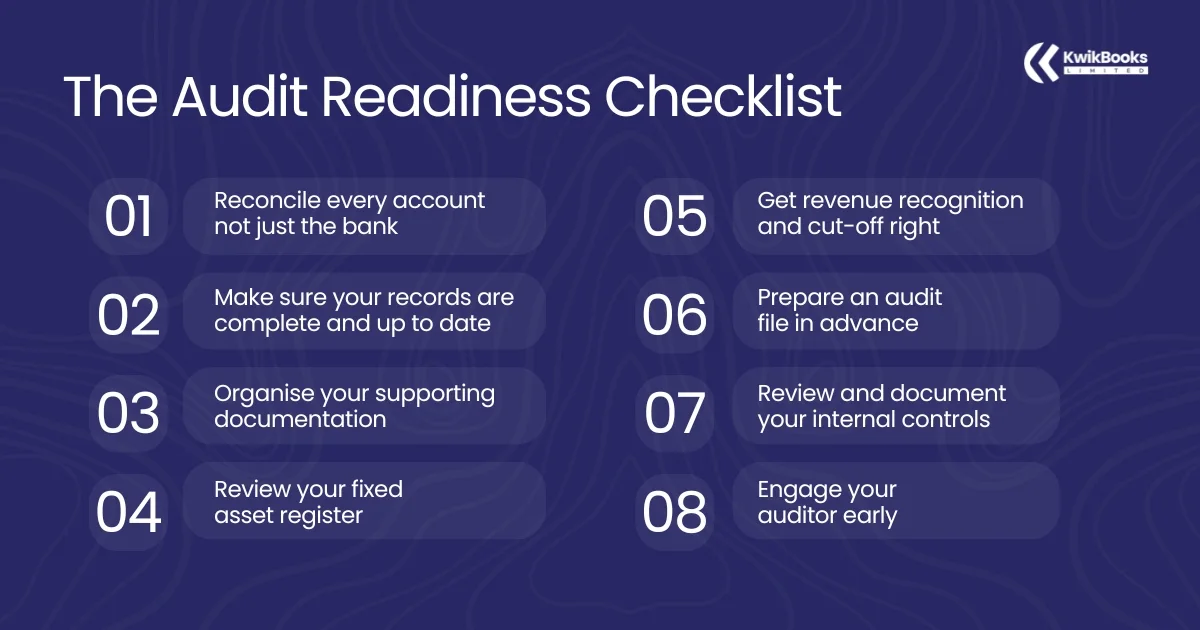
Reconciliation is the backbone of audit readiness. Your bank reconciliation is the obvious one and should be completed monthly with no unexplained differences. But auditors will look well beyond it. Make sure your accounts receivable and accounts payable ledgers agree to your control accounts, that your VAT control account reconciles to your filed returns, that payroll liabilities tie back to PAYE submissions, and that any intercompany balances match across entities. A reconciliation left dangling all year becomes a frantic and error-prone scramble in audit season.
Auditors notice gaps quickly. Every transaction should be recorded, categorised consistently, and posted to the correct period. Avoid the common trap of a “suspense” or “ask my accountant” account quietly swelling throughout the year every item parked there is a question waiting to be asked. If your bookkeeping has fallen behind, bringing it fully current is the single highest-impact thing you can do before an audit begins.
This is where preparation either saves or costs you enormous amounts of time. Auditors will request samples of invoices, receipts, contracts, bank statements, lease agreements, loan documents, and board minutes. If these are scattered across email inboxes, filing cabinets, and three different cloud drives, every request becomes a treasure hunt. Maintain a logical, well-labelled digital filing system organised so that any document can be located in seconds. Cloud accounting platforms that attach source documents directly to transactions are enormously helpful here.
Confirm that your fixed asset register agrees with the figures in your accounts, that additions and disposals during the year are properly recorded, and that depreciation has been calculated consistently with your stated accounting policy. Verify that assets on the register physically exist and that anything scrapped or sold has been removed. This is a frequent source of audit adjustments, and it is entirely avoidable with a periodic review.
Cut-off recording income and expenses in the correct accounting period is one of the areas auditors scrutinise most closely, because it is where errors and manipulation most commonly occur. Revenue invoiced just before year-end but relating to work delivered afterwards, or supplier costs incurred but not yet invoiced to you, both need careful treatment through accruals and prepayments. If your business has more complex arrangements, such as subscriptions, staged contracts, or deferred income, make sure your revenue recognition policy is written down and applied consistently.
Most auditors will send a “prepared by client” (PBC) request list: the schedules, reconciliations, and documents they need to begin work. Rather than reacting to it under time pressure, build your own audit file as the year-end approaches. A strong file includes your draft financial statements, all key reconciliations, lead schedules for major balances, copies of significant contracts, and clear notes explaining any judgements or unusual transactions. Walking into an audit with this assembled is the difference between a two-week engagement and a two-month one.
Auditors assess the systems and controls that produce your numbers, not just the numbers themselves. Be ready to explain how transactions are authorised, who has access to your accounting system and bank, how duties are segregated, and what checks catch errors before they reach the accounts. Even in a small business, demonstrating thoughtful, documented controls builds auditor confidence and can reduce the volume of detailed testing they feel they need to perform.
The smoothest audits begin with a conversation, not a deadline. Talk to your auditor well ahead of fieldwork to agree on timelines, clarify what they’ll need, and flag any significant or unusual events during the year a major acquisition, a new financing arrangement, a change in accounting policy, or a one-off transaction. Surprises are the enemy of an efficient audit. Auditors handle complexity well when they see it coming and far less well when it emerges halfway through testing.
A handful of avoidable issues account for a large share of audit delays and additional fees.
Almost all of these trace back to the same root cause: treating audit readiness as a once-a-year event rather than an ongoing habit.
This is where outsourced bookkeeping earns its keep. KwikBooks keeps client records reconciled, categorised, and fully documented throughout the year, which means audit season stops being a fire drill and becomes a formality. Our team maintains the monthly reconciliations, organised digital documentation, and clean ledgers that auditors expect to see, and we liaise directly with your auditor to handle PBC requests and queries freeing your internal team to keep running the business. Because we work across a wide range of UK companies and sectors, we understand what auditors look for and where time is typically lost, and we build your records around avoiding exactly those friction points. The result is a business that isn’t preparing for an audit so much as already ready for one.
An external audit rewards preparation and punishes procrastination. The businesses that find audits painless are rarely the ones that work hardest in audit week they’re the ones that maintained reconciled, well-documented, consistently kept records all year long. Confirm whether you actually need an audit under the current thresholds, understand what your auditor is trying to evidence, keep your books continuously tidy, and engage your auditor early. Do those things and the audit becomes confirmation of good practice rather than a test of last-minute heroics.
If keeping your records in that state year-round feels like a stretch alongside everything else on your plate, that’s precisely the gap outsourced bookkeeping is built to close and where KwikBooks can take the pressure off long before your auditor ever picks up the phone.
This article is intended as general guidance and does not constitute formal accounting, audit, or legal advice. Audit requirements and thresholds depend on your company’s specific circumstances and may change over time, so always confirm your position with a qualified professional.