
Crossing the VAT threshold is a milestone for any growing business, but it also changes the rules of the game overnight. From the moment you register, your bookkeeping stops being a private accounting exercise and becomes a legal obligation with HMRC watching closely. Every sale, every purchase, and every return has to be recorded accurately, stored digitally, and reconciled to the penny.
At KwikBooks, we work with sole traders, partnerships, and limited companies across the UK to keep their VAT records clean, compliant, and stress-free. This practical guide walks you through what VAT-registered bookkeeping actually involves, the schemes worth knowing about, a simple way to calculate your VAT, and the habits that keep you on the right side of HMRC.
Before registration, bookkeeping is largely about knowing where your money goes. After registration, it becomes a compliance function. You are effectively collecting tax on behalf of HMRC, and your records need to prove exactly how much you have charged, reclaimed, and owe.
The UK VAT registration threshold is £90,000 of taxable turnover in any rolling 12-month period. Importantly, this is a rolling measure, not tied to your accounting year or the tax year. You must check your total taxable turnover at the end of every calendar month, looking back across the previous 12 months. If it exceeds £90,000, you have 30 days from the end of that month to notify HMRC.
Once registered, three things happen to your books at once. You start charging VAT on your taxable sales (output tax), you can reclaim VAT on eligible business purchases (input tax), and you become responsible for submitting periodic VAT returns showing the difference. Get any of these wrong and the errors compound quickly, which is why accurate day-to-day bookkeeping matters more than ever.
Once you are VAT-registered, your bookkeeping must capture far more detail than before. These are the core responsibilities every registered business needs to get right, with the reasons each one matters:
Getting these fundamentals right turns your VAT return from a stressful quarterly scramble into a simple summary of records you have already maintained accurately.
Making Tax Digital (MTD) for VAT applies to all VAT-registered businesses, regardless of turnover. If you are still keeping VAT records in a spreadsheet and typing the totals into the old HMRC online portal, you are non-compliant, because that manual submission route has been switched off.
MTD imposes two central requirements. First, you must keep your VAT records in a digital format, not on paper and not as scanned images of paper. Second, you must submit your returns through HMRC-recognised, MTD-compatible software such as Xero, QuickBooks, Sage, or FreeAgent.
There is also the “digital links” rule that catches many small businesses out. Data must flow from your records to your return through an automated connection, not by manual copy-paste or re-keying. Bridging software is still permitted if you prefer spreadsheets, but it must pull figures directly from your sheet via a genuine digital link.
The penalty regime has real teeth. MTD operates a points-based system: each late VAT return adds a penalty point, and once a quarterly filer reaches four points, HMRC charges a £200 fixed penalty plus a further £200 for each subsequent late return. Late payment is penalised separately, with charges beginning after 15 days and interest accruing on overdue VAT. Robust digital bookkeeping is the simplest way to stay clear of all of it.
If you want a deeper dive into how MTD affects your record-keeping, our guide on Making Tax Digital: What Businesses Need to Know About Bookkeeping covers the practical setup in detail.
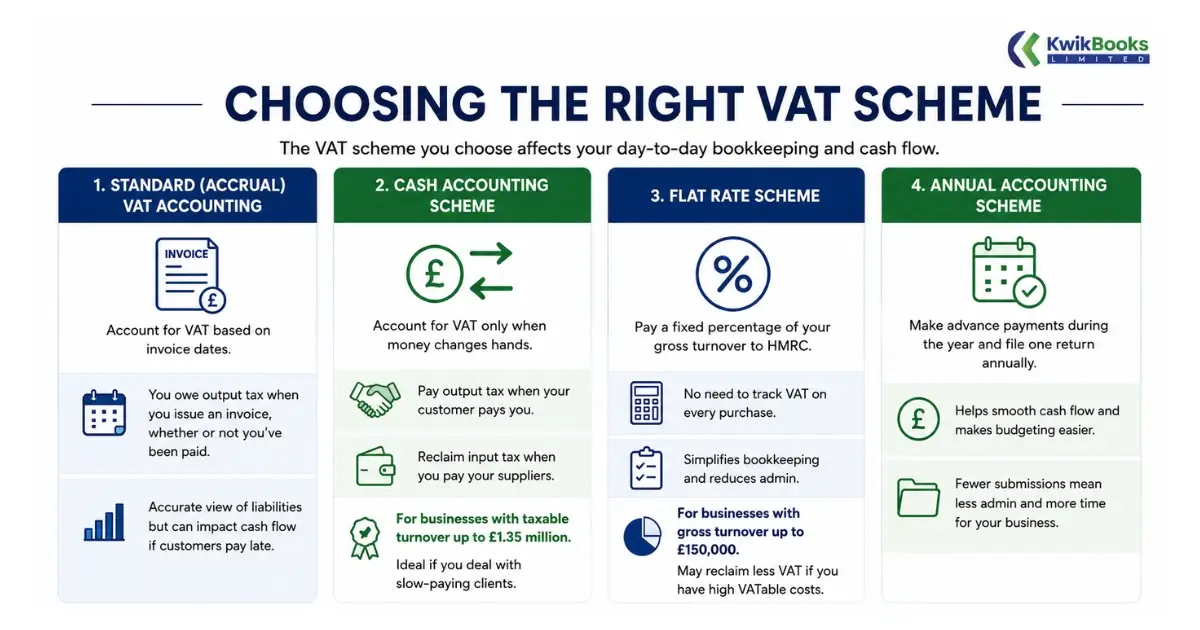
HMRC offers several VAT accounting schemes, and the one you choose has a direct impact on how your bookkeeping works day to day. The right scheme can simplify your records and even improve cash flow, so it is worth understanding the main options before you settle in.
is the default. You account for VAT based on invoice dates, meaning you owe output tax when you issue a sales invoice, whether or not the customer has paid. This gives an accurate picture of liabilities but can strain cash flow if customers pay late.
Lets you account for VAT only when money actually changes hands. You pay output tax when your customer pays you and reclaim input tax when you pay your suppliers. It is available to businesses with taxable turnover up to £1.35 million and is a strong choice if you frequently deal with slow-paying clients, because you never pay VAT on invoices you have not yet collected.
is designed to simplify bookkeeping for smaller businesses with turnover up to £150,000. Instead of tracking VAT on every purchase, you pay HMRC a fixed percentage of your gross turnover, with the exact rate depending on your industry. It reduces admin significantly, though businesses with high VATable costs may reclaim less than under standard accounting, so the maths is worth checking.
allows you to make advance payments towards your VAT bill throughout the year and submit just one return annually. This smooths cash flow and cuts down on filing frequency, which suits businesses that value predictable budgeting.
Each scheme changes what your bookkeeping needs to capture. If you are unsure which fits your business, our team can model the options against your actual numbers as part of our VAT returns and submissions service.
Even well-run businesses trip up on VAT. The most frequent error is reclaiming input tax without a valid VAT invoice, which HMRC will disallow on inspection. Close behind is applying the wrong VAT rate, particularly in sectors like hospitality and construction where reduced and zero rates mix with standard-rated supplies.
Another common problem is failing to account for VAT on the reverse charge, especially in the construction industry, where the Domestic Reverse Charge shifts the responsibility for reporting VAT to the customer. Businesses also frequently forget that fuel, entertainment, and certain vehicle costs carry restrictions on what can be reclaimed.
Perhaps the most damaging habit is treating collected VAT as spendable income. Because the money sits in your account for weeks before the return is due, it is easy to dip into it and then face a shortfall at deadline. Disciplined bookkeeping, ideally with VAT set aside monthly, prevents this entirely. For a wider look at pitfalls, our post on the top 10 bookkeeping mistakes SMEs should avoid is a useful companion read.
The businesses that find VAT painless are the ones with a steady routine rather than a quarterly panic. A reliable rhythm looks something like this: record transactions weekly so nothing piles up, reconcile bank and ledgers monthly, review your VAT position at each month-end, and set aside the VAT you have collected in a separate pot.
Cloud accounting software makes this straightforward. Bank feeds pull transactions in automatically, receipt-capture tools attach evidence to each entry, and your VAT return is effectively assembled as you go. When the filing deadline arrives, you are simply reviewing and submitting rather than reconstructing months of records from scratch. If you are still on spreadsheets or paper, a cloud accounting setup is the single most valuable upgrade you can make.
Official guidance is always worth consulting too. HMRC’s VAT Notice 700 sets out the core rules, and GOV.UK’s VAT record-keeping pages explain exactly what you must retain.
Working out VAT by hand is a frequent source of error, especially when you need to move between net (VAT-exclusive) and gross (VAT-inclusive) figures. A VAT calculator removes the guesswork, and understanding the maths behind it makes your bookkeeping far more reliable.
Here is how the core calculations work at the standard 20% rate:
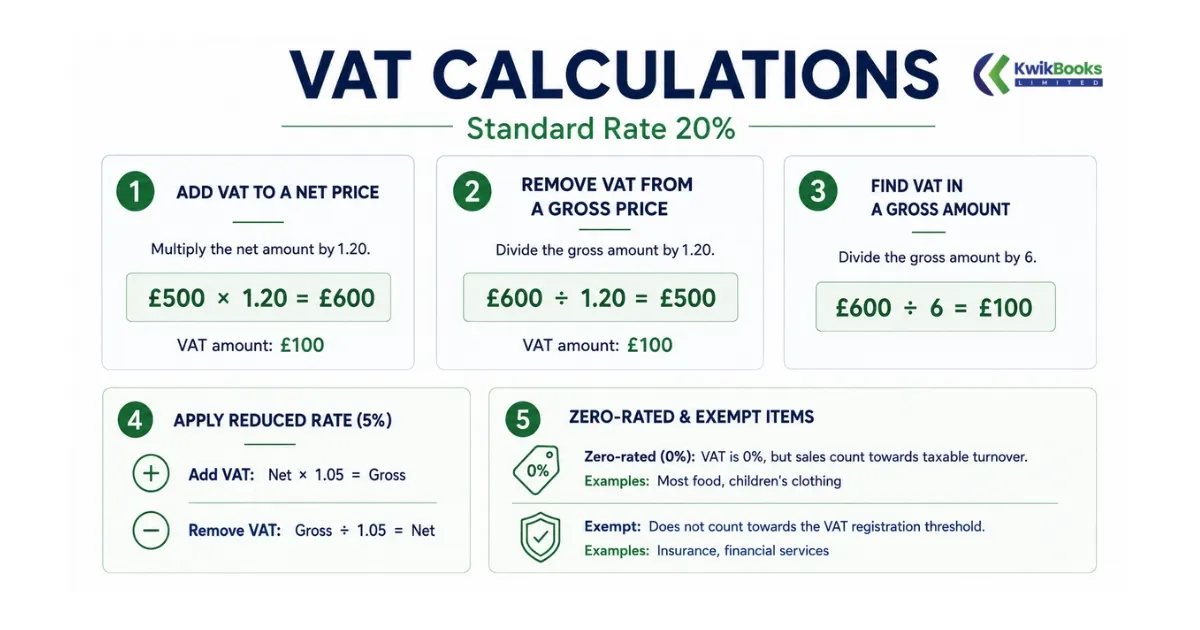
Most cloud accounting software applies these calculations automatically as you enter each transaction, which is exactly why digital bookkeeping reduces errors. If you would like help setting up a system that calculates VAT correctly on every entry, our VAT returns and submissions service takes care of the detail for you.
VAT compliance rewards consistency and punishes neglect. With MTD firmly embedded, a points-based penalty system, and HMRC increasingly focused on enforcement, accurate digital bookkeeping is no longer optional; it is the foundation of a healthy, compliant business.
At KwikBooks, we take that burden off your plate. As UK-based, Xero and QuickBooks certified bookkeepers, we handle your VAT calculations, digital record-keeping, and HMRC submissions so you can focus on running your business. Whether you have just crossed the threshold or want to tighten up an existing process, we are here to keep your books in perfect balance.