
Two businesses can earn identical revenue in the same year, file honest tax returns, and report completely different profits. Neither has done anything wrong. The difference comes down to a single decision made long before the tax return was opened: whether they record money when it moves, or when it is earned.
That choice cash basis or accrual basis shapes the tax you pay this year, the loan you qualify for next year, and how clearly you can see whether your business is actually healthy.
For most UK sole traders and partnerships, this decision has changed fundamentally. Since 6 April 2024, HMRC flipped the default. If you have not actively chosen a method, one has been chosen for you.
This guide explains both methods in plain English, walks through the current rules, and helps you decide which one genuinely suits your business.
Cash basis accounting records income when money lands in your bank account and expenses when money leaves it. Nothing else counts.
If you invoice a client £8,000 in March and they pay you in July, that £8,000 belongs to July. The invoice sitting unpaid on your desk in March is, for accounting purposes, invisible.
Sarah runs a marketing consultancy. In March 2026 she:
Under cash basis, her March figures show £4,000 income and £600 expenses. The £10,000 invoice and the £900 bill wait their turn.
The appeal is honesty about liquidity. Cash basis tells you what is genuinely in the bank, so you never pay tax on money a client has not sent you. If that client goes under and never pays, the income simply never existed no bad debt relief claim, no adjustment, no paperwork.
It is also faster. There is no year-end scramble to calculate debtors, creditors, prepayments, or accruals. No stocktake adjustments. Your bank feed largely is your accounts, which is why cash basis pairs so naturally with cloud bookkeeping software.
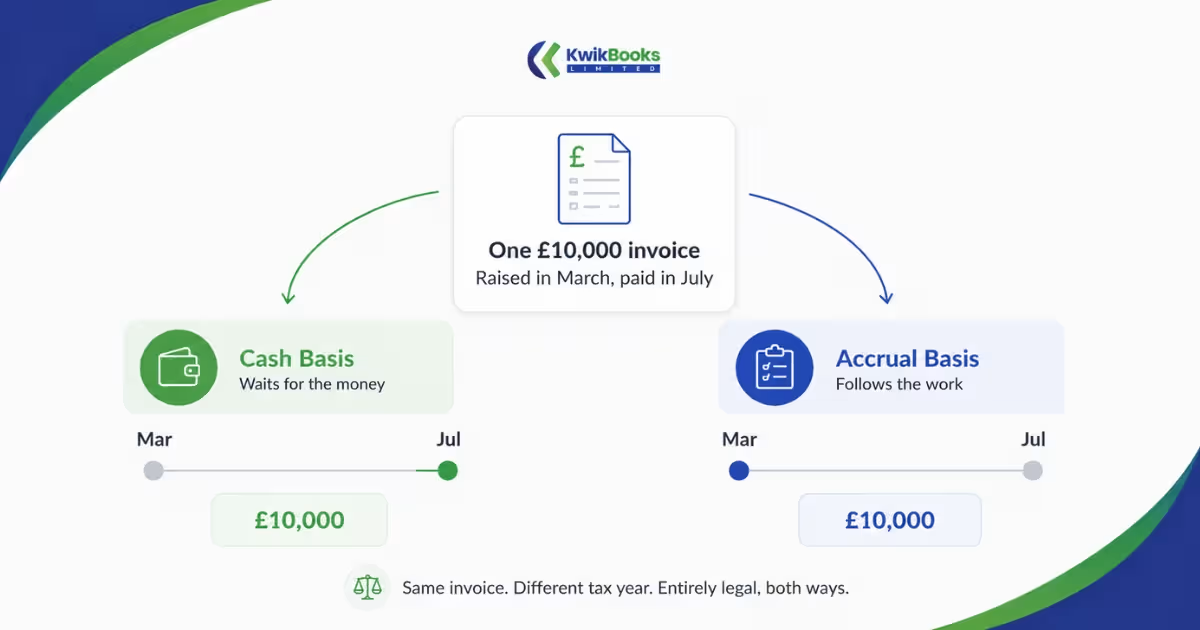 Accrual accounting HMRC calls it “traditional accounting” records income when it is earned and expenses when they are incurred, regardless of when cash moves.
Take Sarah’s March again. Under accrual basis, her figures show £10,000 income (she earned it by delivering the work) and £1,500 expenses (£600 software plus the £900 bill she has committed to). The £4,000 that arrived from January’s invoice was already recorded back in January.
Accrual accounting exists to solve a real problem: matching. It pairs revenue with the costs that generated it, in the period the work happened. A builder who buys £30,000 of materials in December and completes the job in February gets a truer picture by matching that cost to February’s revenue, rather than showing a catastrophic December and a suspiciously profitable February.
That matching principle sits at the heart of double-entry bookkeeping and underpins every set of statutory accounts filed at Companies House.
Accuracy costs effort. Accrual accounting requires tracking what you are owed (debtors), what you owe (creditors), stock valuations, and prepayments. And it introduces a genuine risk: you can be taxed on profit that exists entirely on paper while your bank account is empty.
Factor | Cash Basis | Accrual Basis |
Income recorded | When payment received | When invoice raised / work done |
Expenses recorded | When payment made | When cost incurred |
Complexity | Low | Moderate to high |
Shows true cash position | Yes | No |
Shows true profitability | No | Yes |
Tax on unpaid invoices | Never | Yes |
Bad debt handling | Automatic | Requires formal relief claim |
Stock and WIP tracking | Not required | Required |
Lender and investor preference | Weak | Strong |
Available to limited companies | No | Mandatory |
Available to sole traders | Yes (now default) | Yes (must opt out) |
Available to LLPs | No | Mandatory |
The pattern is clear. Cash basis optimises for simplicity and cash-flow safety. Accrual optimises for accuracy and credibility. Neither is universally superior they answer different questions.
The 2024/25 HMRC Rule Change Every Sole Trader Must Know
This is the section most business owners have missed, and it has real consequences.
From 6 April 2024, cash basis became the default method for sole traders and eligible partnerships calculating profits for Self Assessment. Previously, accruals were the default and cash basis was an opt-in. That has reversed: if you want to keep using traditional accounting, you must now make an election to do so on your tax return, and that election must be made every year it does not carry forward automatically.
What this means practically: if you have used traditional accounting for years and simply filed as usual, check your return. Silence is now a vote for cash basis. Where cash basis was not used for 2023/24, you needed to decide between moving across or electing to stay on accruals.
For the technical detail, HMRC’s helpsheet HS222 covers transitional adjustments, and ICAEW’s Tax Faculty guidance explains where the traps sit.
Eligibility is about legal structure, not size.
Source – ICAEW
This is the single most important filter. If you trade through a limited company, this entire debate is settled for you company accounts must be prepared on an accruals basis under UK GAAP or FRS 102, and filed accordingly.
One useful nuance: from April 2024, if you run more than one unincorporated business, you can apply different methods to each. Previously the choice had to be uniform across all of them.
Cash basis tends to fit when four things are true.
Your work is paid close to when it is delivered. Retailers, cafés, hairdressers, and most hospitality businesses take payment at the point of sale. There is little gap between earning and receiving, so the two methods produce nearly identical numbers, and cash basis gets there with less work.
You do not carry meaningful stock. Consultants, freelancers, coaches, and most service businesses have no inventory to value. Accrual’s stock machinery solves a problem they do not have.
Late payment is a real risk. If you invoice on 60- or 90-day terms and chase payment routinely, cash basis stops HMRC taxing you on money you may never see. For construction and trades businesses working with slow-paying main contractors, this protection is substantial.
You are not seeking external finance. No lender is reviewing your accounts, no investor is running due diligence, and no buyer is valuing your business.
Meet all four, and cash basis will save you administrative hours without costing you insight.
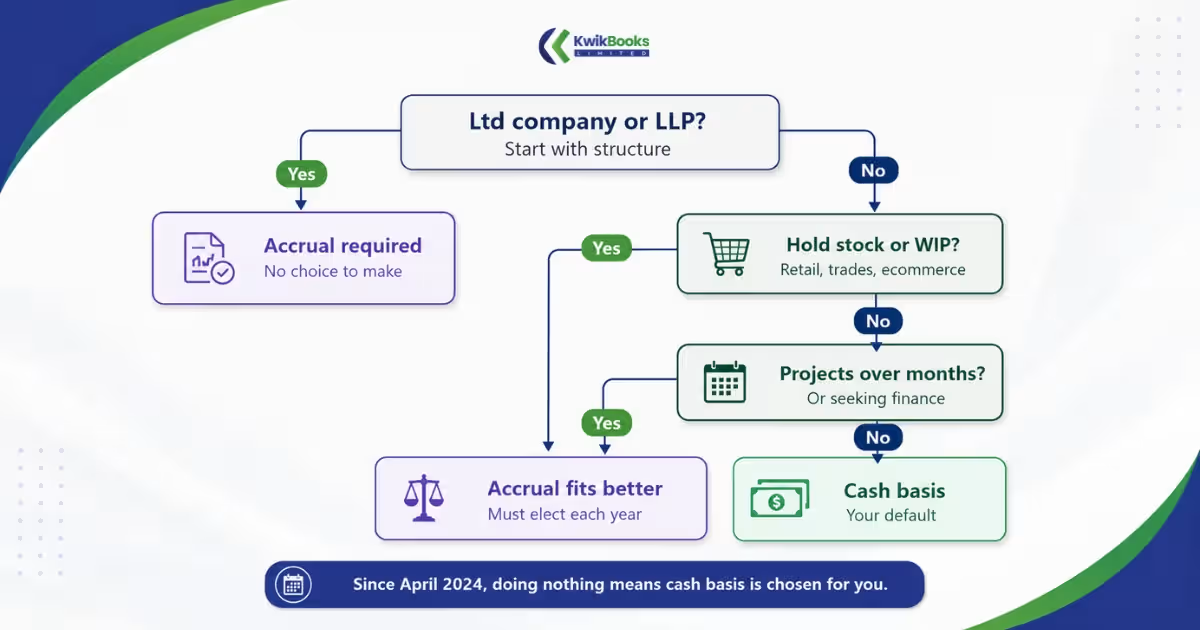
Accrual earns its complexity in specific circumstances.
Banks, investors, and acquirers read accrual accounts. Cash basis accounts obscure the very things they need to assess: margin, recurring revenue, and whether last quarter’s spike was performance or a payment run. If a funding conversation is anywhere on your two-year horizon, build the accrual habit now.
Retailers, manufacturers, e-commerce sellers, and wholesalers cannot understand gross margin without matching cost of goods sold to the revenue it produced. Cash basis will tell you that you had a terrible month because you restocked. That is not information it is noise.
A construction firm on a nine-month contract, or an agency on a retainer with milestone billing, will see wild distortion under cash basis. Revenue clumps at payment dates rather than tracking delivery. One year looks loss-making, the next looks exceptional, and neither reflects what actually happened.
If your customers pay late and your suppliers give you generous terms, cash basis can flatter your position dangerously, showing cash in the bank that is already spoken for.
Then it is not a choice. Accrual accounting is required for your statutory accounts and Corporation Tax return, and clean management accounts and reporting depend on it.
This is the most common misunderstanding we encounter, and it costs businesses real money.
Cash basis (Income Tax) and the VAT Cash Accounting Scheme are entirely separate. Different rules, different eligibility, different elections. You can use one, both, or neither.
The VAT Cash Accounting Scheme changes when you account for VAT. Under standard VAT accounting, you owe HMRC the VAT on an invoice when you raise it even if the customer has not paid. Under the cash accounting scheme, VAT is due only when payment arrives.
To join, your VAT taxable turnover must be £1.35 million or less. You must leave once turnover exceeds £1.6 million in a 12-month period. There is no application process you simply begin at the start of a VAT accounting period. You cannot use it alongside the Flat Rate Scheme. GOV.UK
Critically, a limited company can use VAT cash accounting even though it must use accrual accounting for Corporation Tax. The two systems do not have to agree.
The trade-off: you can only reclaim input VAT after you have paid your suppliers. If your customers pay quickly and your suppliers do not, the scheme works against you.
If your VAT position is complex, our VAT returns and submissions service handles the eligibility check and the mechanics. Full rules are on GOV.UK.
Switching is legitimate and often sensible. Doing it badly is expensive.
The danger is double-counting or omission. An invoice raised under accrual (and already taxed) that is paid after you move to cash basis could be taxed twice. A supplier bill incurred but unpaid could vanish from your records entirely.
HMRC requires transitional adjustments to prevent this. These cover customer debts outstanding at year-end, supplier debts owed, trading stock held, prepayments and accruals, and capital allowances still to be claimed on equipment and vehicles. ACCA Global
A practical sequence:
Reconstructing this from bank statements a year later is possible. It is also miserable. Get the schedule right before the switch, not after. This is exactly the kind of avoidable error we cover in our guide to common bookkeeping mistakes SMEs should avoid.
The cash basis default was not an isolated tweak. It is groundwork for Making Tax Digital for Income Tax Self Assessment.
MTD for Income Tax applies from April 2026 to those with self-employment and/or property income above the qualifying threshold, requiring quarterly digital submissions rather than a single annual return.
The strategic implication is straightforward. Under quarterly reporting, your accounting method stops being an annual afterthought and becomes an operational reality four times a year. Cash basis, driven by bank feeds, is significantly easier to report quarterly. Accrual accounting under MTD demands that debtors, creditors, and accruals stay current throughout the year not reconstructed each January.
From 2026/27, the accruals election will be made through your MTD software rather than a tick box on the return. Low Incomes Tax Reform Group
If you are on accruals and not yet on cloud software, that migration is now urgent rather than optional.
There is no universally correct answer only a correct answer for your business, this year, at this stage of growth.
Choose cash basis if you are an unincorporated business with fast payment cycles, little stock, and no immediate need to impress a lender.
Choose accrual if you hold inventory, run long projects, are planning to raise finance, or trade through a limited company where the choice is made for you.
And whichever you choose, choose it deliberately. Since April 2024, not deciding is itself a decision one HMRC has made on your behalf.
If you are unsure which method your books are currently on, or whether switching would benefit you, that is a conversation worth having before your next return.
Book a free consultation with KwikBooks or call 033 0111 6500. We are Xero and QuickBooks certified, UK-based, and we will tell you plainly which method fits. New clients get their first month of professional bookkeeping free.