
Every successful business, from a one-person consultancy in Leeds to a growing e-commerce brand in London, runs on one quiet foundation: accurate records. When your books are clean, you know exactly how much cash you have, what you owe, who owes you, and whether you are actually making a profit. When they are messy, you are effectively driving with the windscreen fogged up.
Yet record-keeping is the task most business owners push to the bottom of the pile. Receipts pile up in a shoebox, bank feeds go unreconciled for months, and the real reckoning only arrives when a tax deadline looms. The good news is that keeping accurate business records is not complicated once you have a system. This guide breaks down the bookkeeping essentials every UK business needs, why they matter, and exactly how to put them in place.
Before getting into the how, it helps to understand the why. Accurate records are not just about keeping HMRC happy, although that is a big part of it.
Good bookkeeping gives you a live, honest view of your business’s financial health. It tells you which products or services are profitable, when your quiet months hit, and whether a supplier price rise is quietly eating your margins. It is also a legal requirement. In the UK, HMRC requires businesses to keep records that support the figures on their tax returns, and limited companies must comply with the Companies Act 2006 on top of that.
Poor records, by contrast, lead to underclaimed expenses, missed deadlines, penalties, and stressful scrambles at year-end. They can even mask serious problems like fraud or persistent cash-flow gaps. If you want a deeper look at the danger signs, our guide to the top five financial red flags every business owner should watch out for is a useful companion read.
“Business records” is a broad term, and part of keeping them accurately is knowing what you actually need to retain. At a minimum, most UK businesses should hold on to:
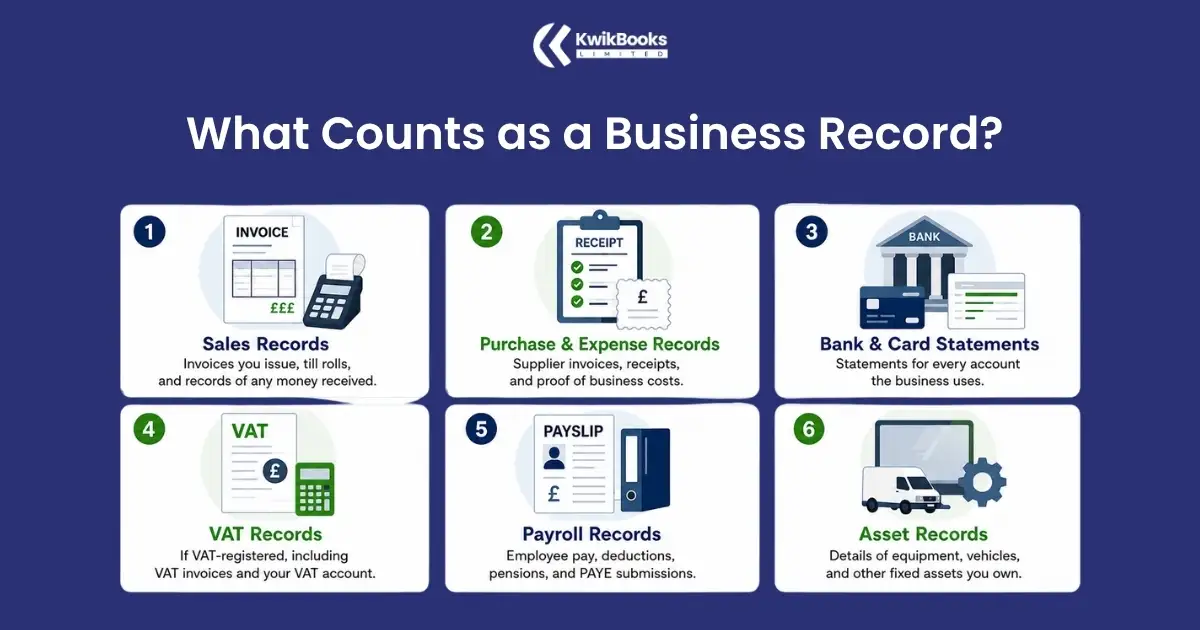
According to GOV.UK guidance on record keeping, self-employed people must keep records for at least five years after the 31 January submission deadline of the relevant tax year, while limited companies must keep records for six years from the end of the financial year they relate to. Getting this retention period wrong is one of the most common compliance slips, so it is worth noting the dates that apply to your business structure.
Now to the heart of the matter. Below are the essential practices that turn scattered paperwork into a reliable set of books. The first two sections are broken down point by point, because these are the areas where getting the detail right makes the biggest difference.
Mixing personal and business money is the single most common reason small business records become a nightmare. Untangling one bank statement full of grocery runs, Netflix subscriptions, and genuine business costs wastes hours and almost guarantees mistakes. Here is how to keep them cleanly apart:
The payoff is huge: cleaner books, easier tax returns, stronger expense claims, and a far simpler picture if you ever apply for finance or sell the business.
Accuracy is as much about timing as it is about method. Records captured weeks after the fact rely on fading memory and lost receipts. Recording little and often keeps your books trustworthy:
Recording transactions consistently is the difference between books that reflect reality and books that merely approximate it.
You do not have to choose between a shoebox and a spreadsheet anymore. Most UK businesses now use cloud accounting software such as Xero, QuickBooks, or Sage. These tools connect directly to your bank, automate much of the data entry, and store everything securely in one place.
Cloud software has become especially important because of Making Tax Digital (MTD), HMRC’s programme requiring many businesses to keep digital records and file returns using compatible software. If you are unsure how MTD affects you, our article on what businesses need to know about Making Tax Digital explains the rules in plain English.
If you are still deciding how to record income and costs, it is also worth understanding the two main approaches to accounting. Our guide comparing cash versus accrual accounting helps you pick the method that suits your business best. And if you want to understand the mechanics behind professional books, double-entry bookkeeping explained is a solid primer.
For many growing businesses, VAT and payroll are where record-keeping gets genuinely technical, and where errors get expensive.
If your turnover crosses the VAT registration threshold, you must keep detailed VAT records and file accurate returns on time. Getting the underlying bookkeeping right makes VAT season painless rather than panic-inducing, as we explain in our practical guide to bookkeeping for VAT-registered businesses.
Payroll carries its own record-keeping obligations, from PAYE submissions to pension contributions and holiday pay. Mistakes here affect real people and attract HMRC attention quickly. Professional payroll processing removes much of that risk while keeping your records clean and compliant.
Even well-intentioned business owners fall into predictable traps. A few to watch for:
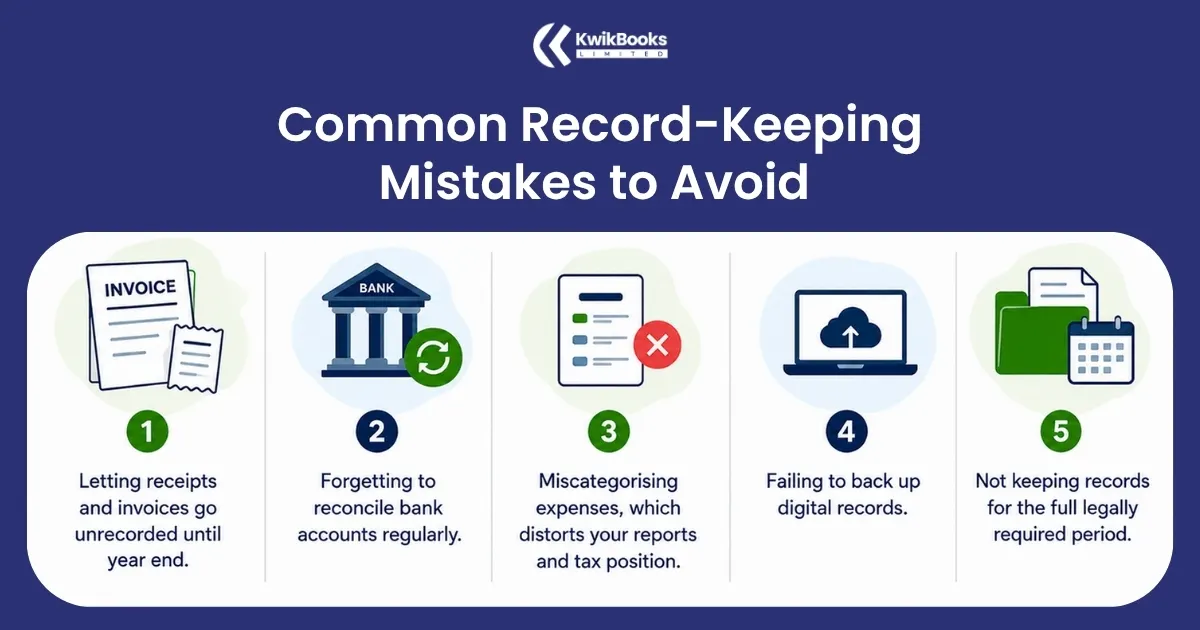
We cover these and more in depth in our roundup of the top 10 bookkeeping mistakes SMEs should avoid. Being aware of the pitfalls is often half the battle.
There is a point in almost every business’s growth where DIY bookkeeping stops being an economy and starts being a cost. If you are spending evenings wrestling with spreadsheets, missing deadlines, or simply unsure whether your figures are right, it may be time to hand the books to a specialist.
A professional bookkeeper does more than data entry. They spot errors, flag cash-flow issues early, ensure compliance, and free you to focus on running the business. If you are weighing it up, our honest look at the true cost of DIY bookkeeping is worth a read before you decide.
At KwikBooks, we help small and medium-sized businesses across the UK keep accurate, compliant, and genuinely useful records. From reconciliations and VAT returns to full cloud accounting setup, our UK-based, Xero- and QuickBooks-certified team keeps your books in perfect balance so you can make confident decisions.
Keeping accurate business records is not about being an accountant. It is about building simple, repeatable habits: separating your finances, recording transactions promptly, choosing the right software, and staying on top of VAT and payroll. Do these consistently and your books stop being a source of stress and become one of your most valuable business tools, giving you clarity, compliance, and control.
If you would rather spend your time growing your business than managing spreadsheets, we can help. Contact KwikBooks today for a free consultation and claim your first month of professional bookkeeping for free.